Research
Project Management
Climate Change Adaptation
Climate Change Mitigation

Funding body
Österreichische Forschungsförderungsgesellschaft - TIKS 2023
Funding amount
180.300€
Consortium
Institute of Building Research & Innovation ZT GmbH (PL)
Gemeinnüzige Wohnungsaktiengesellschaft Wohnpark Alt Erlaa
Universität für Bodenkultur Wien - Institut für Verfahrens- und Energietechnik
Wohnbund:consult eG
Short summary
Decarb Alt Erlaa supports the Wohnpark Alt Erlaa’s transition to climate neutrality through thermal renovation, fossil-free heating, socio-scientific expertise, and the assessment of CO₂ capture solutions within a robust risk and feasibility framework.
Methodology
The methodological approach differed depending on the work package and content focus:
In the area of structural engineering measures, calculations and simulations were used to quantify the effects of various individual measures and packages of measures for thermal renovation.
The proposed building services measures were evaluated quantitatively using calculations and qualitatively using nominal classifications. The calculations were validated with measurements. The winter of 2024/25 was also used for experimental changes to the technical operating parameters of the heat supply.
In parallel with the technical assessments, surveys, focus groups, and participatory formats were conducted as part of the social science monitoring to determine acceptance, information needs, and willingness to participate.
The feasibility study of innovative methods for binding carbon dioxide in operation was based on a combination of literature research, pilot project data, and manufacturer information. For each technology, the mode of operation, technical framework conditions, ecological effects, spatial requirements, and costs were evaluated. In addition, legal aspects, scalability at the neighborhood level, and social acceptance were taken into account.
The risk analysis was carried out using a Failure Mode and Effects Analysis (FMEA) to systematically identify and evaluate potential weaknesses. Based on current planning documents, types of errors, causes, and effects were recorded and quantified using a risk priority number. The analysis was carried out in interdisciplinary workshops involving representatives from the fields of research, planning, social sciences, and ownership.
Objectives
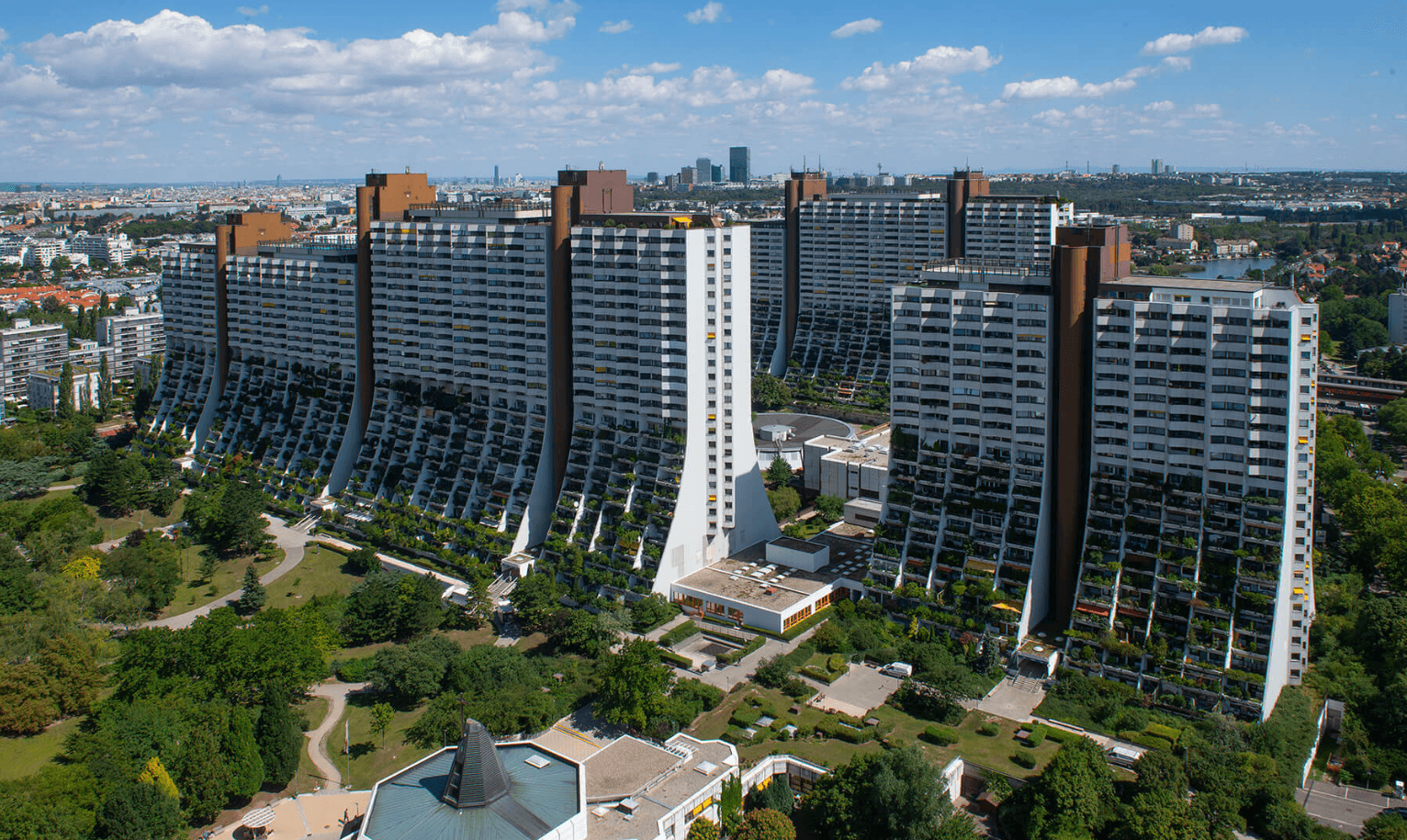
Decarb Alt Erlaa is investigating how the Alt Erlaa residential park—one of Austria's largest housing estates—can be transformed into a climate-neutral and socially sustainable neighborhood. With around 3,000 apartments and a total area of approximately 340,000 m², the residential park offers ideal conditions for developing and testing scalable solutions for climate neutrality on a neighborhood scale.
The aim of the exploratory study is to prepare a well-founded catalog of measures for the transformation. These include: (1) detailed potential analyses of structural and building technology measures, (2) social science support to involve residents in the transformation process, (3) an assessment of the potential and possible integration of innovative technologies for carbon sequestration in the residential park, and (4) the implementation of a risk analysis of technical, organizational, financial, and legal aspects.
Through the systematic evaluation of technical, ecological, and social potentials and risks, the project creates a solid basis for informed decisions.
The results of the exploratory study are currently being implemented in the directly following demonstration project JUNG Erlaa.
Wohnpark Alt Erlaa
© Eveline Tilley
Results
The Decarb Alt Erlaa feasibility study has delivered key insights with high relevance for the project team, the housing owner, and other stakeholders. The systematic building analysis demonstrated that even large, complex housing estates from the 1970s and 1980s can be significantly improved through targeted thermal measures. A complete digital building model and variant-based assessment provided a robust foundation for decision-making, showing that renovations can be both ecologically effective and socially and architecturally sensitive.
A central methodological achievement was linking building-physics modelling with detailed technical evaluation and transparent prioritisation of interventions. This approach allows realistic implementation scenarios in close coordination with planners and property managers and creates a tool that can be adapted for future projects.
The technical potential analysis confirmed the presence of local heat sources, notably the efficient use of wastewater and the suitability of open spaces for geothermal probes, making the transition to a heat pump–based system feasible. Combining thermal refurbishment with lower heating supply temperatures further enhances system efficiency. The study concluded that technical and building measures are most effective when applied together, with the building envelope remaining critical for overall energy performance.
Social-scientific findings were equally important. Measures only achieve their full effect when accompanied by transparent communication and active resident participation. Project-developed engagement formats built trust and acceptance, underlining that social sustainability is an essential dimension of transformation.
The feasibility study of carbon capture measures indicated that soil humus enrichment is limited in impact, while pyrolysis of garden and park waste is technically and economically viable. Carbon capture from air streams has high potential but is currently limited by energy and storage constraints. Prioritising pyrolysis with waste heat recovery will guide the next project phase.
Overall, the results provide a solid foundation for the follow-up demonstration project JUNG Erlaa, where technical innovations and participatory approaches will be implemented at scale. Alt Erlaa’s size and complexity create unique opportunities for monitoring, optimising control strategies, and ensuring comfort while decarbonising the heating system. The findings are transferable to other large housing estates, offering a replicable model for climate-neutral, socially inclusive urban living that is relevant nationally and internationally.