Design
Development
Project Management
Climate Change Adaptation
Climate Change Mitigation
Social Justice

Funding body
Österreichische Forschungsförderungsgesellschaft - Leuchttürme der Wärmewende 2024
Funding amount
555.000€
Consortium
Institute for Building Research & Innovation
GESIBA Gemeinnützige Siedlungs- und Bauaktiengesellschaft
Universität für Bodenkultur Wien Institut für Verfahrens- und Energietechnik
wohnbund:consult
Short summary
JUNG Erlaa is the continuation of the Decarb Alt Erlaa feasibility study and provides scientific support for the transformation of the Alt Erlaa residential park into a shining example of the energy transition, focusing on thermal renovation, heat pump systems, optimized operational management, social integration of residents, risk analysis, and local CO2 sinks through pyrolysis.
Methodology
The methodology combines technical, economic, and social science approaches in large-scale residential housing.
In the technical sphere, the conversion of the heating system to a heat pump system with an anergy grid is accompanied by monitoring, operating data collection, and simulation-based analysis. A digital twin links the building and system simulation with real-time data in order to test control strategies such as predictive control and AI optimization. Different operating modes, storage options, and approaches to summer temperature control are evaluated comparatively. At the same time, the optimized heating load design is evaluated on the basis of planned and actual data.
From an economic perspective, a continuously updated full cost analysis is carried out. Investment, operating, maintenance, and energy costs are systematically recorded and linked to efficiency indicators. Operator and contract models are analyzed in terms of their incentive structures and long-term optimization.
Surveys, participation formats, and real-world laboratories are used to examine acceptance, information needs, and usage behavior from a social science perspective.
Strategic risk analysis is continued as an iterative process. Identified risks are documented, evaluated, and compared with actual events in order to derive reliable success factors and risk factors for comparable transformation projects.
Objectives
JUNG Erlaa aims to provide scientific support for the gradual thermal renovation and decarbonization of the Alt Erlaa residential park. The focus is on converting the fossil fuel heating system to a multivalent heat pump system with an anergy grid and local energy sources such as geothermal probes, wastewater, and exhaust air, as well as reducing heat demand through structural measures.
The goal is to enable technically robust, economically viable, and socially acceptable implementation in large-scale residential construction, while deriving generally transferable findings for comparable existing neighborhoods. To this end, optimal operational management strategies (including predictive control and digital twins), storage options, and potential for summer temperature control are being investigated and evaluated in real-world operation. At the same time, planning, construction, commissioning, and operating costs are being systematically analyzed to create a reliable basis for operator and heat supply models.
Another goal is the proactive involvement of residents to ensure high residential satisfaction during the construction and conversion phase. In addition, local CO2 sinks, in particular pyrolysis of biogenic residues, are being examined in depth to compensate for remaining residual emissions.
Results
JUNG Erlaa is the first comprehensive scientific study of a concerted thermal renovation and heating conversion of a large-scale residential complex with around 3,200 apartments. Reliable, practice-validated findings for the decarbonization of multi-story buildings are expected.
Wohnpark Alt Erlaa
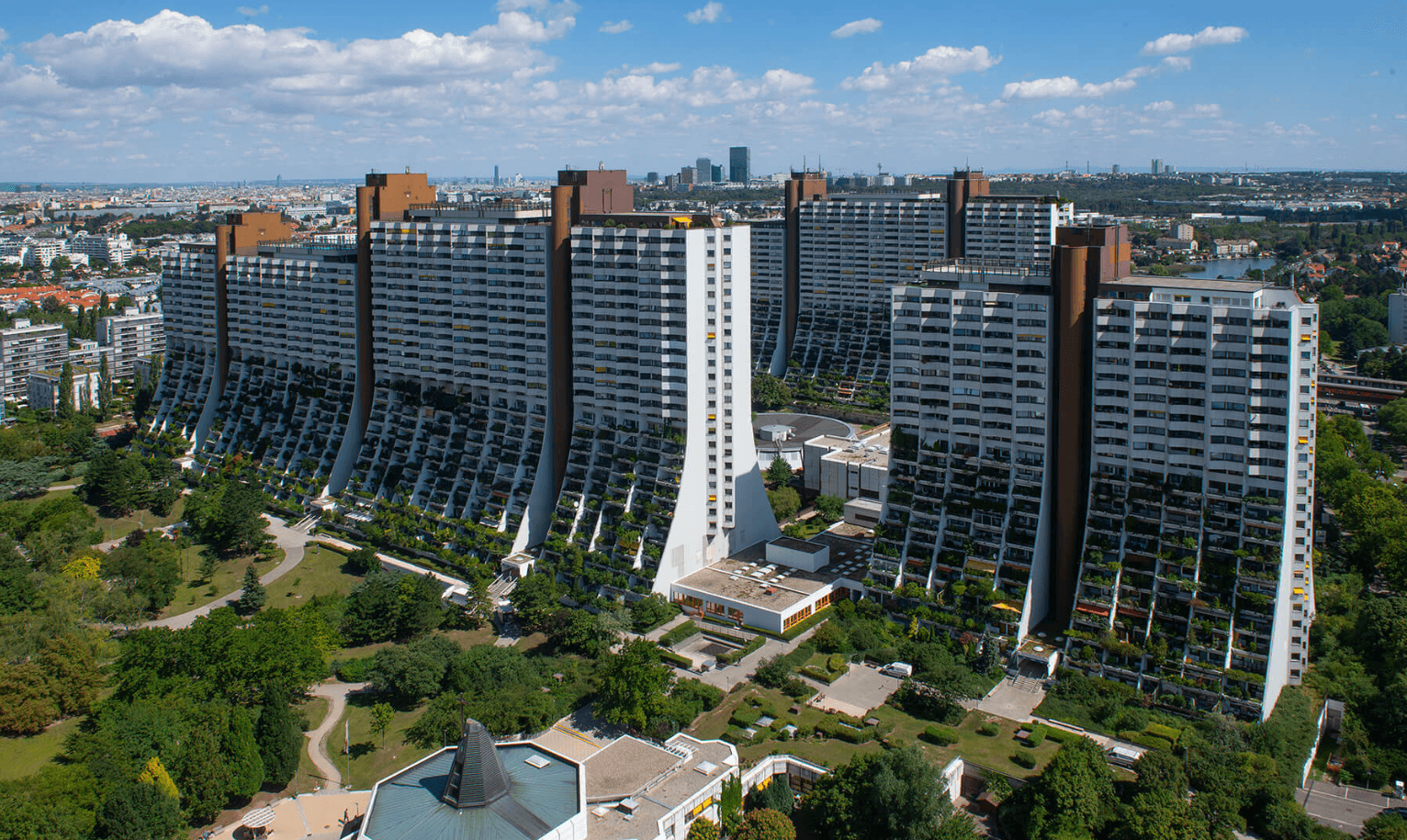
© Eveline Tilley
In the technical sphere, validated simulation models and monitoring data from several identical residential towers are being developed. Different control strategies, in particular predictive approaches and AI optimization, are being tested comparatively in real-world operation. The result is a technical guide for the optimized operation of heat pump systems in existing buildings, which also includes the evaluation of heat dissipation, storage integration, and optimized heating load design.
Economically, a differentiated full cost analysis of investment, maintenance, operation, and energy procurement will be prepared. This will result in transparent decision-making bases for economically viable operational management and an exemplary operational management contract with learning incentive mechanisms.
In the social sphere, a scalable best practice model is being developed to support renovations in large housing estates. With the help of monitoring of residential satisfaction, participatory formats, and energy guides, acceptance factors and effective communication strategies are systematically documented. The results are presented in the form of reports and demonstration videos.
In the field of carbon and nutrient cycles, local biomass potentials are being identified, pyrolysis processes are being tested experimentally, and their energetic integration into the neighborhood system is being evaluated. Quantified potentials for offsetting remaining emissions and transferable models for closing carbon cycles at the neighborhood level are expected.
In addition, success and risk factors from planning, implementation, and operation are systematically documented. The retrospective FMEA and the target/actual comparison provide generalizable recommendations for action for future transformation projects.
Overall, this results in a replicable transformation model for climate-neutral and socially stable large housing estates.